> For the complete documentation index, see [llms.txt](https://help.tillit.cloud/tillit/llms.txt). Markdown versions of documentation pages are available by appending `.md` to page URLs; this page is available as [Markdown](https://help.tillit.cloud/tillit/knowledge-base/setting-up-tillit/integrations.md).

# Integrations

## Overview

Channels, e.g Webhook allows you to send data to other services when specific events are triggered in TilliT

For example, when a specific activity passes in TilliT, you can send the data in a payload to Microsoft Dynamics 365.

{% hint style="warning" %}
For setting up SMS, Email, Push notification and Notification in the TilliT app see the [User Subscriptions](/tillit/knowledge-base/users/manage/user-subscriptions.md)
{% endhint %}

## Navigation

{% hint style="info" %}
Navigation: ***Settings > Integrations***
{% endhint %}

## Configure a Channel

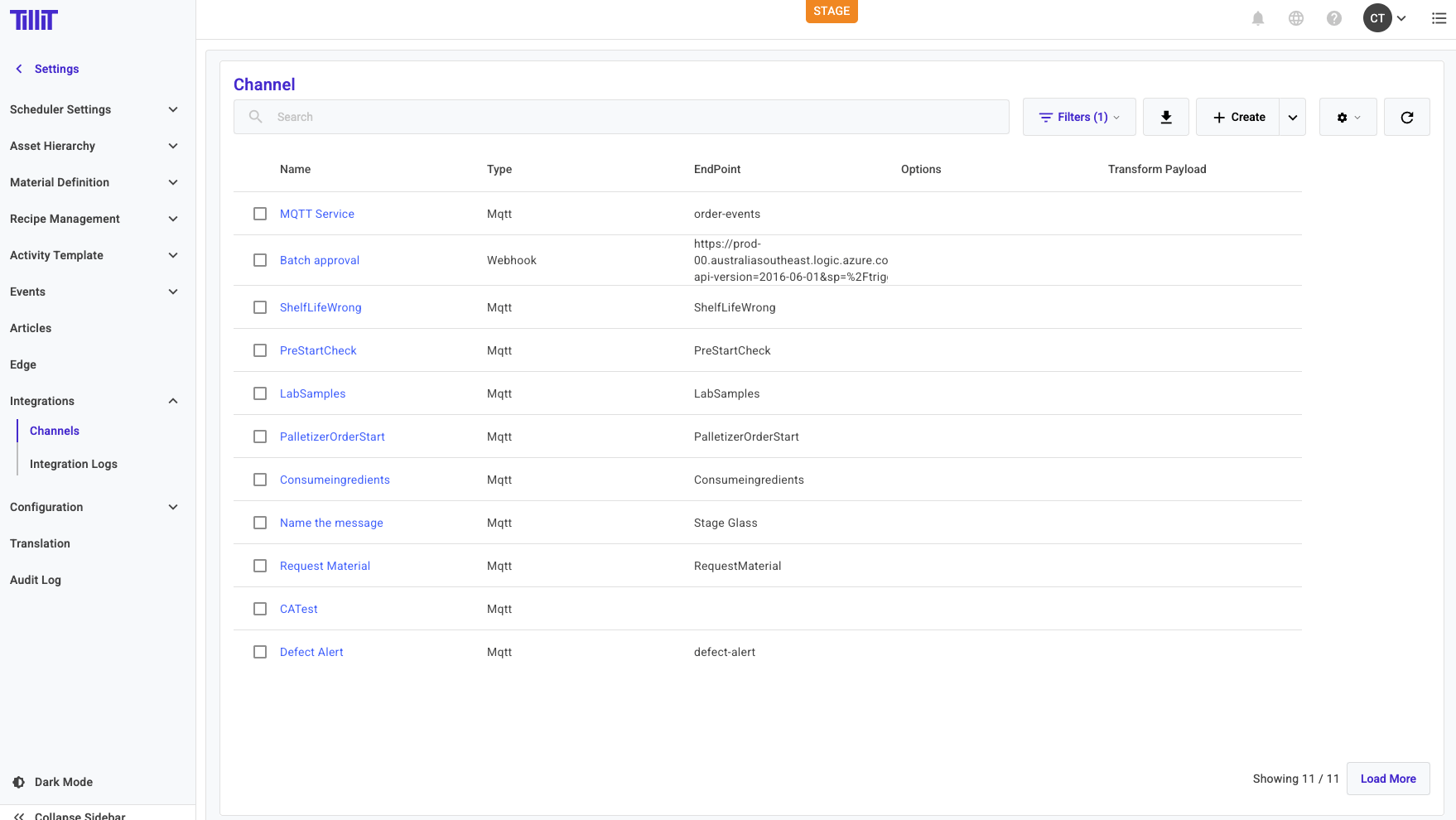
Navigate to Settings > Integrations > Channels and **create** a Channel

<figure><img src="/files/RP3E6L7s01NfdI3Q4PLN" alt=""><figcaption></figcaption></figure>

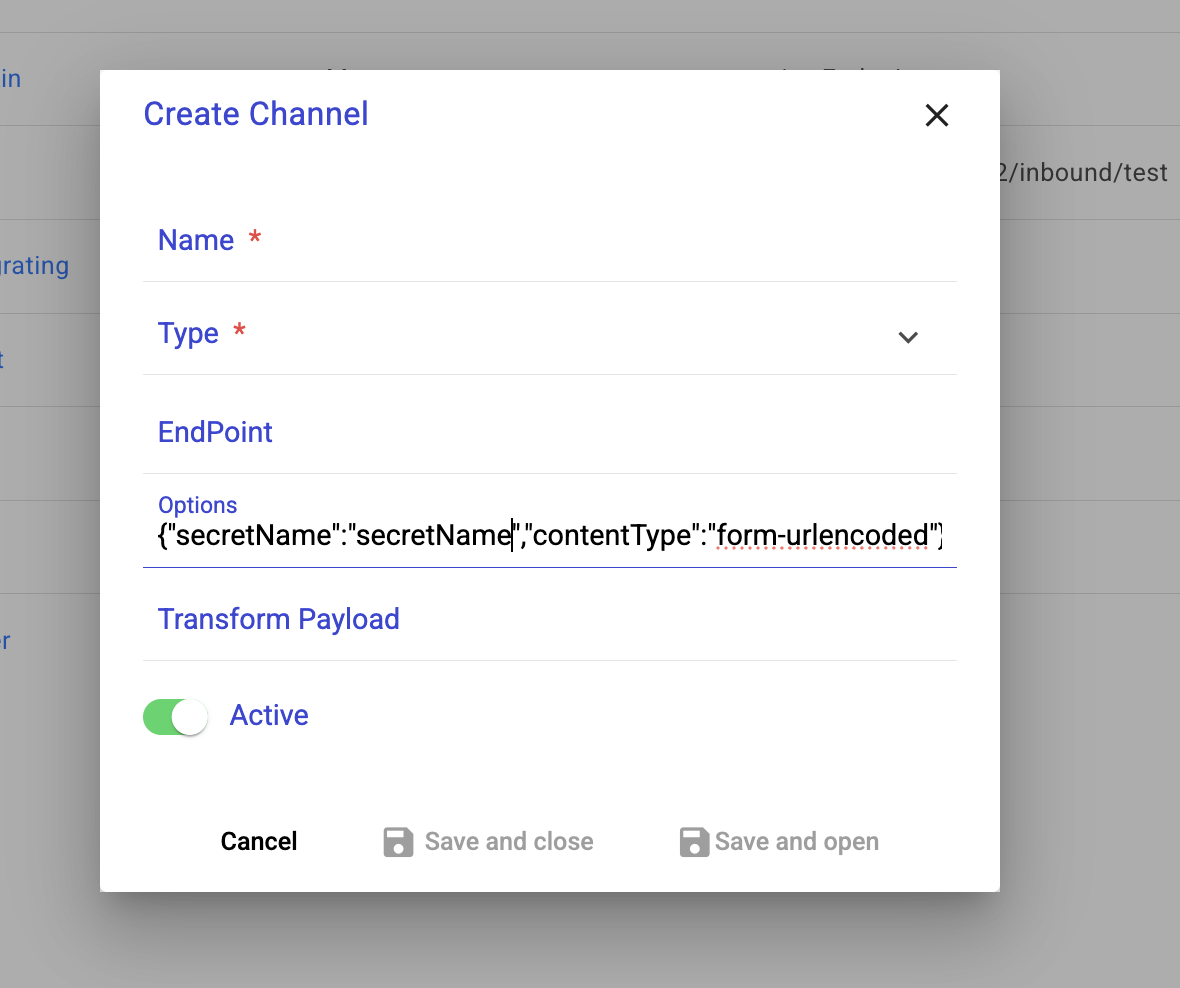
Fill in the form and hit **Save and Open**

<figure><img src="/files/bwTBRD15fCFTDVZqsbvh" alt=""><figcaption></figcaption></figure>

<table><thead><tr><th>Name</th><th>Description</th></tr></thead><tbody><tr><td>Name</td><td>The name of your channel</td></tr><tr><td>Type</td><td>Webhook, MQTT, Sftp, or WireFlow</td></tr><tr><td>Endpoint</td><td>See <a href="https://help.tillit.cloud/api/mqtt-api/subscribe-to-a-tillit-topic">https://help.tillit.cloud/api/mqtt-api/subscribe-to-a-tillit-topic</a></td></tr><tr><td>Options<img src="/files/Q5cNAZRgmHjxLSoyndPi" alt=""></td><td><p>See below for general options and Sft channel options. It should be written as a json object<br></p><pre><code>export type ChannelOptions = {
  username?: string;
  headers?: any;
  authType?: 'OAUTH' | 'BASIC' | 'TOKEN';
  tokenUrl?: string;
  clientId?: string;
  secretName?: string;
  scope?: string;
  grantType?: string;
  jsonata?: string;
  contentType?: string; // Support form-urlencoded content type 
};
export type SftChannelOptions = {
tempFolder?: string;
filePrefix?: string;
host?: string;
username?: string;
port?: number;
secretName?: string;
};
Example:
{
"username": "myName",
"tokenUrl": "tokenUrl.here"
}
</code></pre></td></tr><tr><td>Transform Payload</td><td>This is a jsonata expression. See their documentation here - <a href="https://jsonata.org/">https://jsonata.org/</a>. It is used to reduce the payload size so that only the requirement data will be sent to the channel.</td></tr></tbody></table>

Click the ***Save and close*** button to finalise.

## WireFlow Channel Type

The **WireFlow** channel type allows TilliT events to directly invoke a WireFlow flow. When a subscribed event fires on a WireFlow channel, TilliT triggers the configured flow in your WireFlow environment and passes the event payload to it.

This is useful for building event-driven automation pipelines — for example, triggering a WireFlow flow automatically when an activity completes or an order status changes in TilliT.

{% hint style="info" %}
See [WireFlow](/tillit/knowledge-base/setting-up-tillit/integrations/wire-flow.md) for more information about creating and managing WireFlow flows.
{% endhint %}


---

# Agent Instructions
This documentation is published with GitBook. GitBook is the documentation platform designed so that both humans and AI agents can read, navigate, and reason over technical content effectively. Learn more at gitbook.com.

## Querying This Documentation
If you need additional information that is not directly available in this page, you can query the documentation dynamically by asking a question.

Perform an HTTP GET request on the current page URL with the `ask` query parameter:

```
GET https://help.tillit.cloud/tillit/knowledge-base/setting-up-tillit/integrations.md?ask=<question>
```

The question should be specific, self-contained, and written in natural language.
The response will contain a direct answer to the question and relevant excerpts and sources from the documentation.

Use this mechanism when the answer is not explicitly present in the current page, you need clarification or additional context, or you want to retrieve related documentation sections.