> For the complete documentation index, see [llms.txt](https://help.tillit.cloud/tillit/llms.txt). Markdown versions of documentation pages are available by appending `.md` to page URLs; this page is available as [Markdown](https://help.tillit.cloud/tillit/knowledge-base/track-and-trace/movement-types.md).
# Movement Types
### Overview
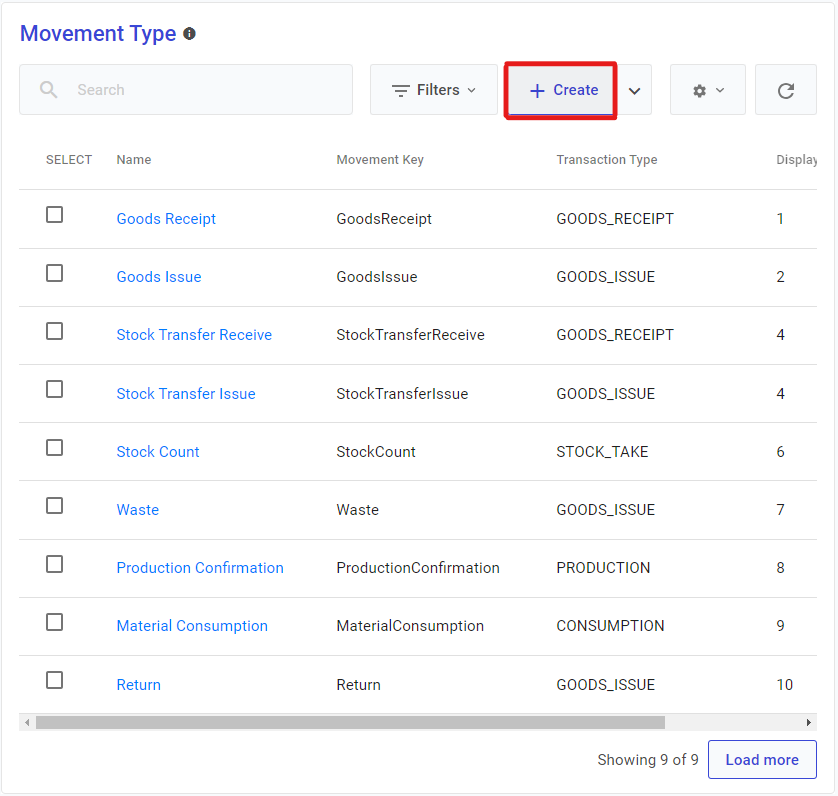
A Movement Type in TilliT is comprised of a transaction type and movement type fields. The movement type defines the specific action that is taking place, such as goods issue, goods receipt, or stock take. The transaction type is the underlying activity being performed, such as consumption or production. Together, these elements provide a framework for accurately recording and managing material movement and inventory transactions in TilliT.
TilliT comes pre-loaded with Movement Types ready to be used. Depending on your business requirements, you may add, edit or delete these for your needs.
### Navigation
Go to **Settings > Configuration > Movement Types > Create**
### Fields
| Name | Description |
| ------------------------ | ------------------------------------------------------------------------------------------------------------------------------------------------------------------------------------------------------------------------------------------------------------------ |
| **ID** | This is generated by TilliT and cannot be changed. |
| **Name \*** | Name of the movment, this is often the name of the business action taking place. |
| **Movement Key\*** | The movement key is a unique identifier for each movement type. |
| **Transaction Type \*** | Defines the logic behind the movement type. |
| **Display Order** | Changes the order in which the item appears in menus across TilliT. |
| **Strategy** | Defines the inventory rotation policy used to automatically select batches. This field is context-sensitive and only appears when the *Transaction Type* is set to *Consumption* or *Goods Issue*. |
| **Availability Type \*** |
Specifies how the system validates material stock before allowing the movement. Options are:
• None: No validation check is performed.
• Asset Inventory: Enforces validation against the actual stock currently allocated to the target Asset.
|
### Inventory Pick Strategies
By default, TilliT requires operators to scan or manually specify a batch identifier (known as an Inventory Key) for every consumption transaction to ensure precise traceability.
The Strategy field allows configuration administrators to automate this process for outgoing movements (Consumption and Goods Issue transaction types).
#### Behavior and Rules
* Standard Manual Mode (Strategy is Blank / Undefined): If no strategy is selected, the system retains its standard behavior. The operator must manually scan or enter the specific Inventory Key (e.g., pallet ID, batch number, or barcode) to submit the consumption.
* Automated Mode (FIFO or LIFO Selected): If a strategy is defined, the operator can submit a consumption entry by entering only the consumed quantity and material, leaving the Inventory Key field blank. The system will automatically select and allocate the stock based on the chosen strategy:
* FIFO (First In, First Out): Consumes the oldest stock sitting on the asset first. This is the standard choice in manufacturing to keep stock rotating and prevent material expiration.
* LIFO (Last In, First Out): Consumes the newest stock sitting on the asset first. This is typically applied in physical scenarios where the newest material is positioned closest to the consumption point.